The Inside of Flipside: Project Critique
Posted: October 24, 2014 Filed under: Uncategorized | Tags: aesthetic journalism, global news, project Leave a commentA VIEW OF A VIEW OF THE VIEW
The Flipside was a promising and thoroughly interesting project which aimed to explore Aesthetic Journalism by covering global issues and events in an online aggregate of striking photographs and short bursts of information.

AIMS
Leah Foster’s desire to explore her curiosity for Aesthetic Journalism is really evident in the hard work she has put into developing and collecting content for the website she has produced. The Flipside aimed to create an aggregation of information sourced from various photographers, journalists and researchers – and it did just that. The fine detail that has been put into the choosing of every photograph and text collected shows the aims for this project were achieved.
There was an importance placed on quality – after all, an aggregate could simply be an infinite collection of content from ALL sources. In the case of The Flipside, the aim was not just to aggregate information, but to maintain quality control on what was aggregated.
This of course ties in nicely with the concept of aesthetic journalism. The quality of the information and photographs that have been “hand-picked” reflects this importance on aesthetics and lends itself to creating a news site that looks beautiful.
CONCEPTS
The concept of Aesthetic Journalism is defined by Cramerotti (2011) as “artistic practices in the form of investigation of social, cultural or political circumstances” (pp.21). In Australia’s Journalists’ Code of Ethics, it is considered a new way of dissecting politics, informing citizens and ‘animating democracy’.
The Flipside does just that. Each story investigates the global issue and/or event in a level of detail that reflects hard work. Collating not only these beautifully composed photographs but subtitling each one with a quote or sentence that link off to various other news sources, really makes the investigation of these stories feel thorough, objective and reliable.
In terms of the design of the concept, it was really beautifully thought out. I love the branding: the title, ‘The Flipside’ is really catchy, giving this idea that there is ‘another side’ to the stories.
‘A view of the view’ is even a catchy slogan. The whole concept that the stories are termed as ‘Flips’ is so short and catchy, and I think it’s actually my favourite thing. There’s even an upside-down landscape photo, which, although not executed perfectly, would be a brilliant idea for branding, if this project were to continue in the future.

METHODOLOGY
The methodical approach to this project was effective. Despite her disappointment that the site did “not have a wide reach”, Leah clearly understands the audience she is targeting and how to get global news to appeal to them.
For me personally, I found it a much more appealing way to access these global news stories. I was never able to comprehend what was actually happening in these news stories due to the overwhelming amount of information, but this site makes it appealing simple to take in and understand, while linking you off to sites for further reading.
Most of these short bursts of information that come with each photo is actually a quote. I like having the quotes while you look at images – rather than just stating facts, you read quotes that are varying perspectives.
I did find, however, that many links only went to a page that was just the image again. It would be nice if every link went off to another news source. There was an inconsistency with the linking which confused me and didn’t allow me to learn more. Even if at the end of each ‘Flip’ there was a list of sources for ‘further reading’, that would be really useful.
The twitter account for The Flipside also reflected this thoroughness in aggregating information.
BETA PRESENTATION
Many issues with The Flipside were brought up through the Beta Presentation.
There is a major functionality and accessibility issue with this site. While The Flipside is appealing and accessible in terms of its content, the actual construction of the site is appalling. Wix should never be used to construct sites. The site design itself, while I could see what was trying to be achieved, ended up looking extremely messy. There are way too many fonts, colours and textures happening.
You can’t open links in new tabs, the gallery has functionality issues. With Wix, there is no easy way to access this site on mobiles as there is no responsive design. The site needed to have a simpler layout, which could simply be the heading, a slight description, followed by a massive grid of all the stories. Hey, maybe even have the ‘Flips’ literally flip upon hover-over, with a small description of the story on the back for even more ease of accessibility.
The main issue with The Flipside is that the project does not aim to extend itself or continue after the assignment is complete.
If it were to continue however, I could see it going on to becoming a news app for phones, which would open up simply as a grid of ‘Flips’. People could each day go on to look through a bunch of photos and see quotes and information that links to other sources for big global news stories happening at the time.
Sadly, the scope for the project was limited and it will probably not continue despite its potential. It needed to be detached from being considered a university assignment at all, so that online promotion could have brought audiences to the site because to them, it is an actual proper news site.
Despite me bundling all the negatives at the end of this critique, I thoroughly enjoyed this project, the aims, the concepts and the production of the content itself. While Wix let The Flipside down and it is not going to continue, there is potential there for a really appealing and successful news site.
You can visit The Flipside at: viewoftheview.wix.com/theflipside
REFERENCES
Cramerotti A 2011, ‘What is Aesthetic Journalism’, Aesthetic Journalism: How to Inform Without Informing, Intellect, London.
Trending: Emma Watson
Posted: September 24, 2014 Filed under: Uncategorized | Tags: 4chan, actor, celebrity culture, culture, feminism, films, heforshe, marketing, men, speech, UN, women Leave a comment
I tell you what, it’s been a mad week for Emma Watson. What began as a powerful speech made by the UN Women’s Goodwill Ambassador, suddenly turned into an online threat that ended as a marketing strategy for online censorship. Could you tick any more boxes on the media-and-communications-front?
Earlier this week, Emma Watson made an inspiring speech at the UN Women’s #HeForShe campaign presentation in Uruguay, encouraging men to “climb aboard the feminist train and end gender inequality once and for all“.
‘Feminism by definition is: “The belief that men and women should have equal rights and opportunities. It is the theory of the political, economic and social equality of the sexes,’ she said.
Sadly, the #HeForShe campaign became shadowed quite quickly by a big steaming pile of shit.
On reporting the event, The Daily Mail decided to cut straight to the important information about the campaign: “[Watson] wore an elegant oatmeal dress with blazer structuring on top and pleated skirt on the lower half”. Wow, a pleated skirt!

“She later changed into a sleeveless black silky midi-length dress for a party in honour of the occasion,” The Daily Mail continued to report with a dizzying amount of photos of her outfit AS IF THEY DIDN’T QUITE UNDERSTAND THE WHOLE CONCEPT OF THE ACTUAL CAMPAIGN THEY UNFORTUNATELY FORGOT TO REPORT ON.
Meanwhile, The Debrief, shared an article with an attached video which essentially was a montage of Watson in various outfits at film premiers. “We’ve always known Emma Watson was smart as a tack”, they wrote. “[Watson] could have happily sat atop her cushy Harry Potter millions, but instead went to Ivy League US college Brown, graduating with honours.”
It’s like WOW?? A woman?? Who has lots of money from being in films?? But instead chose to go to college?? The Debrief needs to try and act less surprised about a woman being intelligent.
Imagine if these articles were written about a famous male actor doing a speech– oh wait.


No one seems too surprised that DiCaprio knows what he’s talking about. While Watson gets reported on her outfits and the shocking fact she went to college, Dicaprio just gets quoted on important parts of his speech.
Thankfully, Facebook is doing it right with Watson trending online for the actual speech.

Source: Facebook
Of course, the shit didn’t end here. It eventuated that a (probably fedora-clad) 4chan user was threatening to reach into the cloud and leak Watson’s nudes, via EmmaYouAreNext.com.

If there were any clearer a message that we need feminism, this was it. “If only her nudes got leaked and she had the load on her face. Her feminism kick would be over,” one commenter on the 4chan site wrote. Okay then.
And just when you thought it was all going so terribly, it actually got worse. …

Source: http://www.abc.net.au/news/2014-09-24/emma-watson-threats-actually-stunt-to-shut-down-4chan/5766882
#Shutdownrantic #shutdown4chan Rantic is hijacking #heforshe and @EmWatson for monetary gain! pic.twitter.com/fMdbakGLWg
— Shane L (@WayneTheCaveman) September 24, 2014
It’s hard to comment on this without getting insanely angry. Sure, Rantic can start their own little campaign aiming to #shutdown4chan. But promoting this campaign by faking a website that was threatening an actor who had done nothing wrong and simply made a speech on feminism? This is not the right way to go about it Rantic.
Rantic? Are you insane?
As a result, many people were worried this would shadow Watson’s speech and it seemingly has for the most part.
So, of course, what we need to remember is that Emma Watson made us all proud this week by making a speech as the UN Women Goodwill Ambassador for the #HeForShe campaign. Sure, she was wearing a dress. No, we don’t need to know about it. No, her nudes aren’t being leaked.
And yes, Rantic are a bunch of dicks.
Diasporic Media: The Importance of Self Representations
Posted: May 19, 2014 Filed under: BCM310 | Tags: asylum seekers, diasporia, diasporic media, empathy, media, media space, minorities, place, public sphere, refugees, reporting, sensationalism, space, today tonight, transnational, truths Leave a commentMedia space is a widely contested space where diasporic groups are mostly excluded due to the fact that they are less directly involved in the production of media content (Georgio, 2003). This is why Diasporic Media is essential, as the perspectives and stories of minority groups not only need to be heard, but they need to be told by the people themselves.
In a post-globalised world, diaspora has become a broad definition for the dislocations of groups of people, one such group being that of asylum seekers, which is a perpetually heated topic in Australia.
It is important for asylum seekers to be represented in the correct way, since they are regularly dehumanised in Australian media, such as this example on 7‘s Today Tonight. This report created uproar with its misleading statistics and information on how ‘boat people’ are living luxuriously in Australia.
As a media and communications student, I completely understand that the information told to us through current affair programs like Today Tonight is not only sensationalised but falsified, but I need to also realise that there is a majority of Australians who watch these programs and believe every word they hear.
So do programs like SBS’s Go Back To Where You Came From (video above) help fight this representation? Well, not really. SBS’s reality TV show took five ‘average Australians’ overseas to show them the reality of asylum seekers. Over the three-part series you see the individuals change their perspectives and become more empathetic. This is all the show really does, by offering a humane perspective (Thornley, 2011).
However, even in this series statistics are misleading, being shaped to create an empathetic reaction. One opinion piece criticises the series by saying it “has real people in real places, but it remains an exercise in manipulation for everyone involved” (Sheehan, 2011).
What we need is truths to be told about these diasporic groups. And the easiest way to get these truths is by enabling minorities to represent themselves. Which seems obvious but “they never offer the ownership of the means and process of communication to those who experience displacement are seeking refuge in another place” (Salazar, 2012).
Digital stories like these created by Cambodian and African migrant youth from Fairfield and Blacktown areas allow them to tell their stories. Instead of trying to create representations for these diasporic groups, we need to enable them to tell their own stories. We need to give minorities the opportunity to create their own identities and enable them to do it in their own way (Rodriguez, 2001).
REFERENCES
Salazar, J F 2012, ‘Digital Stories and emerging citizens’ media practices by migrant youth in Western Sydney’, Journal of Community, Citizen’s and Third Sector Media and Communication, vol.1, no.7, < http://web.a.ebscohost.com.ezpr oxy.uow.edu.au/ehost/detail?vid= 3&sid=c5373eb0-b85c-44ea- b3e5- cc2e901acc61%40sessionmgr40 03&hid=4201&bdata=JnNpdGU 9ZWhvc3QtbGl2ZQ%3d%3d#db= ufh&AN=79551905 >
Georgiou, M 2003, ‘Mapping Diasporic Media across the EU: Addresing Cultural Exclusion’, Key Deliverable: The European Media and Technology in Everyday Life Network, < http://www.lse.ac.uk/media@lse/ research/EMTEL/reports/georgiou_2003_emtel.pdf. >
Rodriguez, C 2001, Fissures in the Mediascape: An International Study of Citizen’s Media, New Jersey, Hampton Press.
Thornley J 2011, ‘Go back to where you came from: Reality TV encounters the refugee crisis’, weblog post, The Conversation, 21 June, viewed 19 May 2014, < http://theconversation.com/go-back-to-where-you-came-from-reality-tv-encounters-the-refugee-crisis-1905 >
Sheehan P 2011, ‘You call this even-handed? Refugee series is strictly for the gullibe’, 23 June, viewed 19 May 2014, < http://www.smh.com.au/federal-politics/political-opinion/you-call-this-evenhanded-refugee-series-is-strictly-for-the-gullible-20110622-1gfav.html >
#Budget2014: Bye Bye Australia Network
Posted: May 14, 2014 Filed under: BCM310 | Tags: ABC, Asia Pacific, audiences, Australia Network, broadcasting, budget, budget2014, channels, communications, controversy, cuts, international, lifestyle, media, media convergence, networking, news, platforms, television, Tony Abbott, transnational, worldwide audience 1 Comment
Source: http://australianetwork.com
The Budget for Australia this year has, to say the least, not been very popular. While there are many aspects to the Budget which have people in an uproar, there was one aspect I wanted to focus on in terms of Global Media and Communication – the cutting of The Australia Network from the Australian Broadcasting Corporation.
The ABC has had its budget cut by $120million, which directly impacts on The Australia Network, which ABC’s managing director Mark Scott has said will be disappointing audiences (Leys, 2014).
The Australia Network is a free-to-air television channel that broadcasts to over 40 countries in Asia and the Pacific. This creates an international network between many countries with news, lifestyle, drama and sports programming – and specifically, it’s English language learning programs.
This network is to provide “a credible and independent voice through programs that present a ‘window’ on Australia and Australian perspectives of the world” (Downer, 2006).
But now this network will be cut due to Abbott’s 2014 budget. Here is what the ABC had to say about this.
The ABC had only just entered into a contract with the Department of Foreign Affairs and Trade. Scott has emphasised that countries across the globe are expanding international broadcasting and prioritising media as a public diplomacy strategy.
“It sends a strange message to the region that the government does not want to use the most powerful communication tools available to it to talk to our regional neighbours about Australia,” Scott said (Leys, 2014).
Sinclair and Harrison in their article on Globalisation from 2004, focuses on case studies of India and China. They highlight that “television has emerged as a medium able to cross the boundaries within and around Greater China … and to engage in complex ways with global forces of culture and commerce” (pp.42).
It is important for Australia to have an international network that establishes global diplomacy because it creates concrete relationships between other countries. Thus, the cutting of The Australia Network is something that impacts negatively upon global media and communication.
REFERENCES
Sinclair, J & Harrison, M 2004, ‘Globalisation, Nation, and Television in Asia: The Cases of India and China’, Television and New Media, vol.5 no.1, < http://tvn.sagepub.com/content/ 5/1/41.short. >
Downer, A (Minister for Foreign Affairs, Australia) 2006, Australia’s Television Service to the Asia-Pacific Region, media release, 10 July, Foreign Minister, viewed 14 May 2014, < http://www.foreignminister.gov.au/releases/2006/fa076_06.html >
Leys, N 2014, ABC budget response, media release, 13 May, ABC, viewed 14 May 2014, < http://about.abc.net.au/press-releases/abc-budget-response/ >
The Fine Line of Accurate Racial Representations
Posted: May 6, 2014 Filed under: BCM310 | Tags: audience, blackface, communication, controversy, culture, entertainment, ethnicity, hey hey its saturday, media, media issues, midsomer murders, minorities in America, misrepresentation, race, racism, representation, television, underrepresentation, worldwide audience Leave a comment
Misomer Murders – is this a racist show? / Source: http://www.thetimes.co.uk/tto/life/article2947513.ece
In 2008, a study found that while 32% of the US population was caucasian males, they were represented on cable TV 57%, while other demographics such as Latino men, who made up 8% of the population, were only represented 1%.
Racial and ethnic minorities have always been misrepresented and underrepresented in the media, and today these minorities are still not represented accurately, begging the question whether enough is being done to fairly portray all races and ethnicities.
Even if we believe that more fair and accurate representations of minorities are on offer these days, media producers are constantly weighed down by the Burden of Representation.
Following the 9/11 attacks, there was a conscious effort to highlight that Arab and Muslim Americans were not the enemy, that Arab and Muslim terrorists were. However, TV shows began to portray these minorities in America as the “unjust victim[s] of post-9/11 discrimination”, which would be all well and good if it didn’t mean concluding that it is “inevitable that Arabs and Muslims will have to deal with discrimination” (Alsultany, 2013).
Marginalised groups were often portrayed as the bad guys, but this sympathetic approach is no better. What we see here is an attempt to portray these minorities in a positive light, that actually comes off as allowing the audience to feel sympathetic for ‘the enemy’ (Alsultany, 2013).
There is a fine line between an accurate representation and an unfair one, even if the intention is good.
Other such cases include Australia’s 2009 debacle on Hey Hey It’s Saturday, where men wore ‘blackface’ to create a comedic performance parodying The Jackson Five. What was supposed to be taken as comedy created controversy linked to black history where ‘blackface’ theatre depicted black people in “a degrading manner” (Mahony, 2009). Here the fine line between comedy and racism was moon-walked along.
In 2011, BBC TV show Midsomer Murders’ producer came under fire for saying that putting ethnic characters in the show would not work. Was this wrong? While it appears discriminatory, the caucasian cast of the show accurately portrays the English village. “The point about Midsomer Murders is that, in a village in Midsomer, all outsiders are equally unwelcome whatever their colour. If your family has lived here for 300 years, they’re likely to be white. That’s quite obvious.” (Horowitz, 2011).
This show is merely being historically and geographically accurate. Is it still wrong of them to not have ethnic characters?
I think what we need to realise is that an accurate presentation of an ethnicity or race is not necessarily that of an overly positive and sympathetic image, but the all-encompassing collective of a wide range of different media that portrays all different aspects of these groups. With this rich collection of media, our minds can be opened to the different stories that exist within these groups and the narrow-minded stereotypes we have learnt over time can be thrown away. This is the only way we can escape the dangers of the single story.
REFERENCES
Alsultany, E 2013, ‘Arabs and Muslims in the Media after 9/11: Representational Strategies for a “Postrace” Era’, American Quarterly, vol.65, no.1, < http://muse.jhu.edu/journals/american_quarterly/v065/65.1.alsultany.html >
Clarke, M 2010, ‘White Australia has a blackface history’, Overland, < http://overland.org.au/previous-issues/issue-199/feature-maxine-clarke/ >
Easton M 2011, ‘Is it ever OK for TV dramas to be all-white?’, BBC News, < http://www.bbc.com/news/magazine-12748293 >
Mahony, M 2009, ‘What’s all the fuss about “blackface”?’, Crikey, < http://www.crikey.com.au/2009/10/08/crikey-clarifier-whats-all- the-fuss-about-blackface/ >
Singh A 2011, ‘Midsomer Murders is not racist, says Anthony Horowitz’, Telegraph, < http://www.telegraph.co.uk/culture/tvandradio/8383788/Midsomer-Murders-is-not-racist-says-Anthony-Horowitz.html >
Stick to the Script: Gender in the Media
Posted: May 2, 2014 Filed under: BCM310 | Tags: 500 days of summer, film, gender, gender norms, gender roles, girls, media, orange is the new black, public sphere, public sphere of imagination, roland barthes, scripts, sexism, stereotypes, television, the newsroom Leave a comment
We all know what stereotypes are, and I’m sure we’ve all been reduced to one at some point in our lives. Stereotypes create assumptions and notions of groups of people in an attempt to evaluate everyone as one thing, rather than as individuals.
It’s this same concept that applies to scripts. Scripts are like stereotyping but for situations and events – which is one of the most powerful ways the media influences us. Scripts tell us how we are supposed to experience the world. As Roland Barthes once said, “myth naturalises history“: here, the media establishes what the conventions and norms of society should be. This discourse analysis allows the media to become active in constructing ideologies.
The public sphere of imagination can create these ideologies while also challenging them. Film and television shows of the last decade have begun to do just that. We’ve had both HBO’s Girls and The Newsroom attempting to challenge gender ideologies, but both have come under scrutiny. The Newsroom is attacked for having stories where “men commit acts of brave journalism and women help them do that” (Ryan, M & Lacob, J 2014), while Girls, very popular for its alternative and refreshing view on women, is even under attack for being racist in its casting and representation!
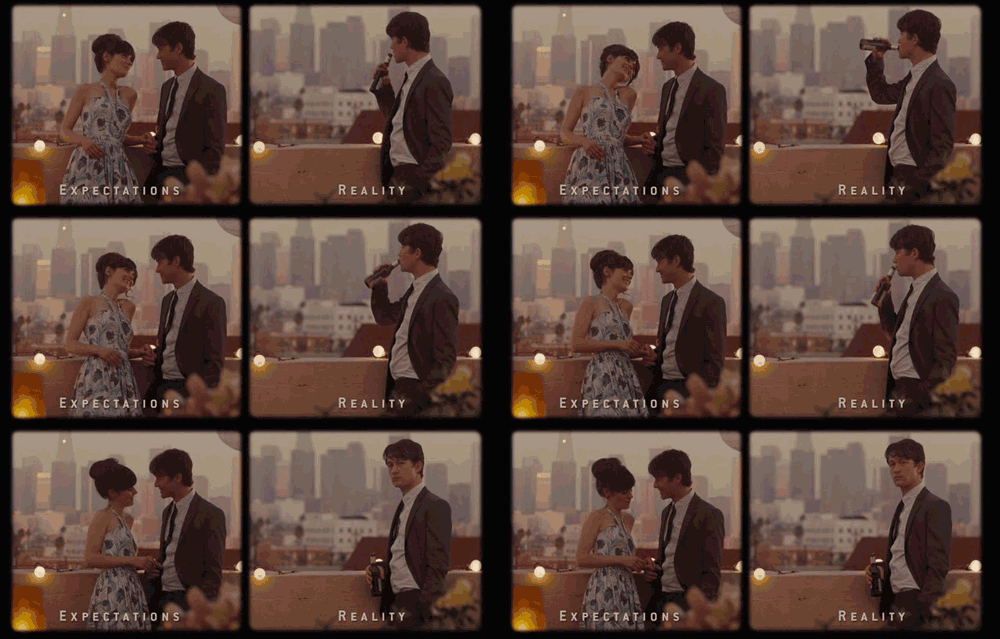
500 Days of Summer is a perfect example that came up in mind. Here we are subjected to a film claiming that it is ‘not a love story‘.
What the film does do right is destroy the concept of the love story, attempting to challenge the assumptions of the perfect relationship, that we are influenced by the media to believe. In the scene pictured above, there is a direct contrast between expectations and reality, challenging these conventional ideas.
But in addition, by attempting to put a twist on the regular love story, we are left with reversed genders in the on-screen relationship. We see Joseph Gordon-Levitte’s character playing the feminine role because he is clingy and attached while Zooey Deschanel’s character is playing the masculine role because of her distant and unloving character. And so the film is back under scrutiny again!
While we can all sit here in front of our TVs and scream about discrimination in the programs and films we watch, we must also understand and accept that we have all been brought up in a world where we have been conditioned to these gender norms and for many, it’s hard to get out of this rut. Only time will allow us to develop an understanding that these stereotypes and scripts are merely ideas put in our heads, and that we too can challenge them.
REFERENCES
Kelly, L W 2013, ‘For us, by us? Gender, privilege and race in HBO’s Girls’, CST Online, weblog post, 26 July, viewed 2 May 2014, < http://cstonline.tv/for-us-by-us-gender-privilege-race >
Ryan, M & Lacob, J 2012, ”The Newsroom’: Women Problems Abound in Aaron Sorkin’s HBO Series’, Huffington Post, weblog post, 2 July, viewed 2 May 2014, < http://www.huffingtonpost.com/maureen-ryan/the-newsroom-women-aaron-sorkin-hbo_b_1641982.html >
Less newsrooms, more news
Posted: April 16, 2014 Filed under: BCM310 | Tags: audience, consumer, convergence, digital media, future, gatekeepers, journalism, media, millenials, new media, newsroom, old line media, old media, prosumer, revenue, TEDx, traditional journalism, virtual 8 CommentsThere’s always a lot of negativity surrounding the future of journalism – people are quick to list the detrimental effects that new media is having on traditional journalism. Newspaper revenue is down 40%! Newsroom staff down 30%! The audience for television news has halved since the 80s! The horror!
All these statistics are going down, but that doesn’t mean we are turning away from the news. In fact, we’re consuming more news these days than ever before.
In the video above, Tom Rosenstiel talks about old media and how gatekeepers force-fed us the news they thought we should know. Now? We can access any news at any time about anything we want.
Gatekeepers are a thing of the past, and the ‘virtual newsroom’ is becoming a shared space for content creators and prosumers. “The audience will determine the future of news”.
In this video interview for Boston University, David Carr and Andrew Lack discuss the future of journalism but emphasise that they don’t want to spend time discussing the past as “‘back in the day’ is such a bore”.
Lack claims that nothing about journalism in the past was good, that journalism is now in its prime. In real time, we are now able to verify sources via various social networking sites. “The bag of tricks that the average journalist has is so much bigger than it used to be”.
In fact, Lack argues that the ‘escalator’ of hierarchy in news organisations no longer exists – employment in journalism doesn’t come down to your experience in various papers and working your way up, it comes from making things with “your own two dirty little hands” he muses.
There is a convergence of old line media and new media present – while journalists are still being employed, they are being employed to make a range of multimedia to share their stories.
By the year 2020, 50% of the workforce will be ‘millenials’ – people who were born into the digital media era, people my age who have grown up naturally learning and adapting to all new forms of digital media. We are the ones who will take ownership of these workplaces and transform them into something new and different.
REFERENCES
TEDx Talks 2013, The Future of Journalism: Tom Rosenstiel at TEDxAtlanta, online video, 28 May, TEDx, viewed 16 April 2014, < https://www.youtube.com/watch?v=RuBE_dP900Y >
Bloomberg Media 2014, NYT’s David Carr on the Future of Journalism, online video, 6 March, Boston University, viewed 16 April 2014, < https://www.youtube.com/watch?v=WPlazqH0TdA >
COMMENTS
http://gabilesteruni.wordpress.com/2014/04/16/escalator-to-nowhere/
http://michalaj.wordpress.com/2014/04/16/the-changing-shape-of-journalism/
Aesthetic Journalism: a well-needed makeover
Posted: April 12, 2014 Filed under: BCM310 | Tags: aesthetic journalism, audience, controversy, convergence, entertainment, hate crime, homosexuality, journalism, matthew shephard, media, prosumers, public sphere, social-media, verbatim theatre, viral Leave a comment
Aesthetic journalism is just one aspect following the concept of The Public Sphere of Imagination, a new way of dissecting politics, informing citizens and ‘animating democracy‘.
Drawing from the words of Roland Barthes that “myth naturalises history”, we are now finding ourselves applying this to convergent media: ‘myth’ (cultural, social and entertainment media) can be seen to ‘naturalise’ (or establish conventions and norms) in ‘history’ (politics).
Entertainment media can come in all forms – we’re talking art exhibits, festivals, fashion, performances and remix culture. Even cities want to attract creative classes through expression of modernity and progress (Pratt 2011, pp.124). This kind of media can directly impact upon the political sphere, despite it’s artistic and narrative nature.
One example that comes to the forefront often is that of the case of Matthew Shephard. Matthew Shephard was a young gay university student who was bashed to death in Wyoming, USA. He is one of millions of cases of violence against minorities, however his case was especially interesting due to the immediate spark of public outrage.
Vigils for Matthew were held across the US, as a statement of anti-hate, from people who didn’t know him. His death led to political activism, aesthetic activism, a foundation in his name, songs, books, films and theatre productions.
This is a prime example of aesthetic journalism, of art and journalism colliding. Cramerotti defines it as “artistic practices in the form of investigation of social, cultural or political circumstances” (2011, pp.21).
A play inspired by the events called The Laramie Project, adheres to this definition. The Laramie Project is verbatim theatre – where a play is created from the words of real life interviews conducted in a community. The words of these interviews about Matthew Shephard were journalism, and then used creatively as aesthetic journalism.
My only question is that of objectivity. Cramerotti goes on to say that journalism is supposed to serve to inform, not as “an opportunity to influence decisions and gain power” (pp.22).
There is a fine line in aesthetic journalism between what is news and what is opinion. But I suppose all will become clear as journalism begins to naturally shape itself to the prosumers of today.
REFERENCES
Cramerotti A 2011, ‘What is Aesthetic Journalism’, Aesthetic Journalism: How to Inform Without Informing, Intellect, London.
Pratt, A C 2011, ‘The cultural contradictions of the creative city’, City, Culture and Society, vol. 2, pp. 123–130.
Journalismgate: rebuilding the newsroom
Posted: April 1, 2014 Filed under: BCM310 | Tags: a rational fear, audience, broadcast, citizen journalism, convergence, digital journalism, generative platforms, mainstream media, media, news, newspapers, online news, social networking, traditional medium, twitter, watergate 5 Comments
Source: http://www.macalester.edu/news/
If you haven’t heard anything about the fall of traditional mainstream journalism, then you’ve been living under a rock. Even if you’ve been living under a rock, surely you overheard someone going on about how newspapers are a thing of the past, or that digital journalism is taking over, or newspapers are dramatically losing readership, or journalists are out of the job.
Well, yes. That is the case. With the rising popularity of digital journalism, the traditional means of communicating news to the public are becoming less and less frequented. As a result of this loss of readership, advertising has dropped considerably as well. Big companies are finding alternative ways to effectively advertise. And, I mean, have you even thought about putting a classified in the paper in the last 10 years? Everyone’s just been using the internet.
Accessing news via the internet is so much easier, but it is interesting to look at where people are getting their news. Sure there are official news websites – including the much-talked-about digital conversion of The Guardian – but people are also getting their news from blogs, Twitter, Facebook and Youtube.
In fact, seven out of 10 adults under the age of 30 say that they get some of their news from social media, and “audience participation opportunities in online newspapers [are] redefining journalistic culture, values and practices” (Domingo D et al., 2008, pp. 327).
Do not believe for one second that journalism is dead. It is merely transforming to suit the digital era, to suit the wants of an audience that prefer videos, apps and games to get their news fix.
The Friday Times have said that “YouTube and Facebook have appealed more effectively to the people than those presented by mainstream media”.
Take A Rational Fear for example. It is a topical comedy show that focuses on political and social satire in Australian, doing live recordings, podcasts and videos like the one below:
Lewis Hobba discusses the drinking, smoking and environmental laws in Sydney’s nightlife district in a comedic way. Not only are you getting informed, but you’re being entertained through video made purely for online sharing. And, wouldn’t you know it, I found this video via Facebook!
So cancel the funeral, journalism hasn’t died – if anything, it’s been reborn and is trying to find its feet. And if this is where journalism is going, I kind of like it.
REFERENCES
Domingo D, Quandt T, Heinonen A, Paulussen S, Singer J & Vujnovic M 2008, ‘Participatory Journalism Practices In The Media And Beyond,’ Journalism Practice, vol.2, no.3, p. 326-342.
HT Media 2011, ‘Innovation Journalism’, The Friday Times.
Orange is the New Sphere of Public Imagination
Posted: March 31, 2014 Filed under: BCM310 | Tags: citizen journalism, controversy, gender, laverne cox, media audiences, melissa harris-perry, narratives, orange is the new black, politics, public, public imagination, public sphere, race, race relations, sexuality, television industries, transgender, transmedia narratives, women of colour 2 Comments
Source: http://www.indiewire.com/
Roland Barthes once said “myth naturalises history”. What he meant by this was that global institutions create the illusion that the current system of life that is in place is natural and conventional.
This is applicable to traditional forms of media, where content has to go via a gatekeeper before being published. We all know that the content we are fed through traditional media is shaped to alter our perspectives for the benefit of these Media Giants.
But this is not the case anymore. New Media has brought a whole new level to how we communicate and learn new information, allowing more than just the dominant institutions to tell us what to think.
It can be seen through citizen journalism, one of the very first examples being of a video recording of the beating of Rodney King in 1992. Berkowitz states that audiences have reduced their intake of conventional journalism and are replacing it with content that satisfies more, “for a better perspective on what journalism means” (2009, pp. 291).
This footage had a major impact on race relations, sparking the 1992 Los Angeles riots.
Fictional TV shows and films can also have the same effect. The narrative (myth) of a TV show can naturalise the same concepts in real life.
Orange is the New Black is a TV production that is beginning to have such an impact. Not only is it entertaining, but it also exposes truths on the dehumanising occurring in US prisons as well as initiating discussion over sexual orientation, gender, race and class.

On US talk show Melissa Harris-Perry, Orange was discussed in terms of how a narrative can bring to light real political issues. Piper Kerman, author of the book of the same name, states that “In my experience and my opinion, the statistics are very overwhelming but they become meaningless to folks who are really, really willing to tune out statistics. But stories get them in their gut and their heart and they stay with them.”
Sophia Bursets’ story in the series has been highly influential. Sophia is a transgender woman of colour who the audience has connected with. The actress who plays her, Laverne Cox, a transgender woman of colour herself (and the first to be on maintream TV) has expressed surprise at how positive the response to the character has been.
With just this character, the political sphere has already been impacted upon, with stories about real-life transgendered woman of colour in prison being exposed.
Orange is not only the new black but also the new example of the sphere of public imagination at work.
REFERENCES
Berkowitz, D 2009, ‘Journalism In the Broader Cultural Mediascape’, Journalism, vol.10, no.3, pp. 290-292.
McGuian, J 2005, ‘The cultural public sphere’, Cultural Studies, vol.8, no.4, pp. 447-443.
Renninger B 2013, ‘Orange is the New Black’ Cast Members Defend the Show’s Politics on ‘Melissa Harris-Perry’, Indiewire, 6 August, < http://www.indiewire.com/article/television/watch-orange-is-the-new-black-cast-members-defend-the-shows-politics-on-melissa-harris-perry >